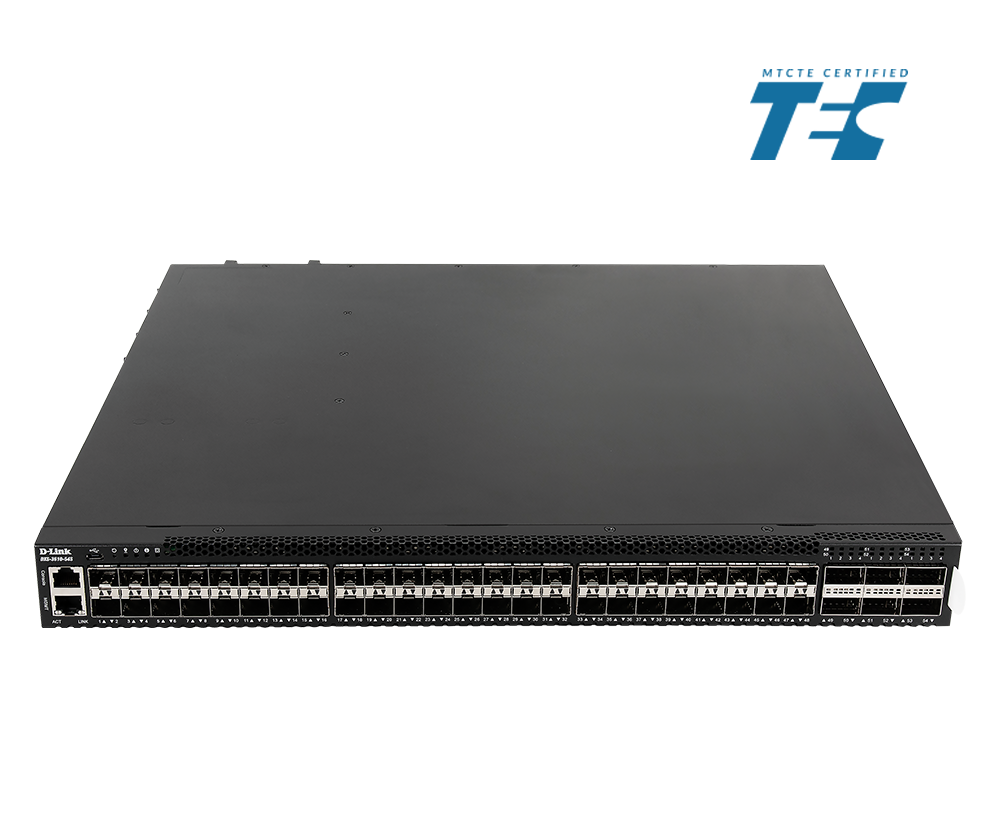
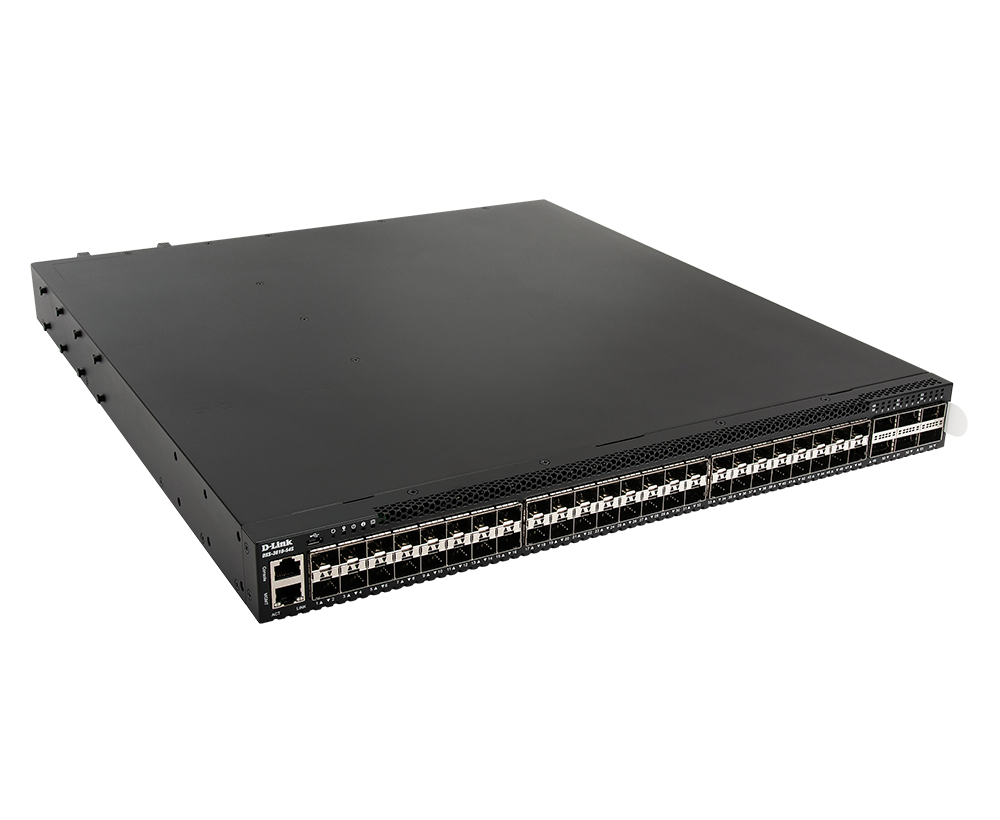


Open Linux NOS lineage, OVS/OpenFlow readiness, enterprise fabric features and D-Link value-adds that make this product production-ready across core, DC and industrial use-cases.
D-LinkNOS combines an enterprise L2/L3 stack with modern automation and telemetry primitives — agents and management tooling running natively on the switch.
Overview:
D-LinkNOS runs on a Debian userspace and exposes Linux kernel interfaces — making the switch a first-class citizen in CI/CD pipelines. Operators can run configuration management, telemetry collectors and custom scripts directly on the device. No additional servers or out-of-band orchestration boxes required for day-2 operations.
Why it matters:
Deployments that treat the network as code gain faster rollouts, reproducible configurations and integrated telemetry-driven operations. D-LinkNOS supports common automation frameworks so network changes can be managed using the same toolchains as compute and storage.
Business value: accelerated feature delivery, lower operational friction, consistent lifecycle and monitoring across infrastructure.
Ansible, Chef, Puppet, Salt
gNMI, OpenConfig, NETCONF, REST API
ZTP via ONIE, Signed Images, Rollback
Syslog, sFlow, Streaming Telemetry
Overview:
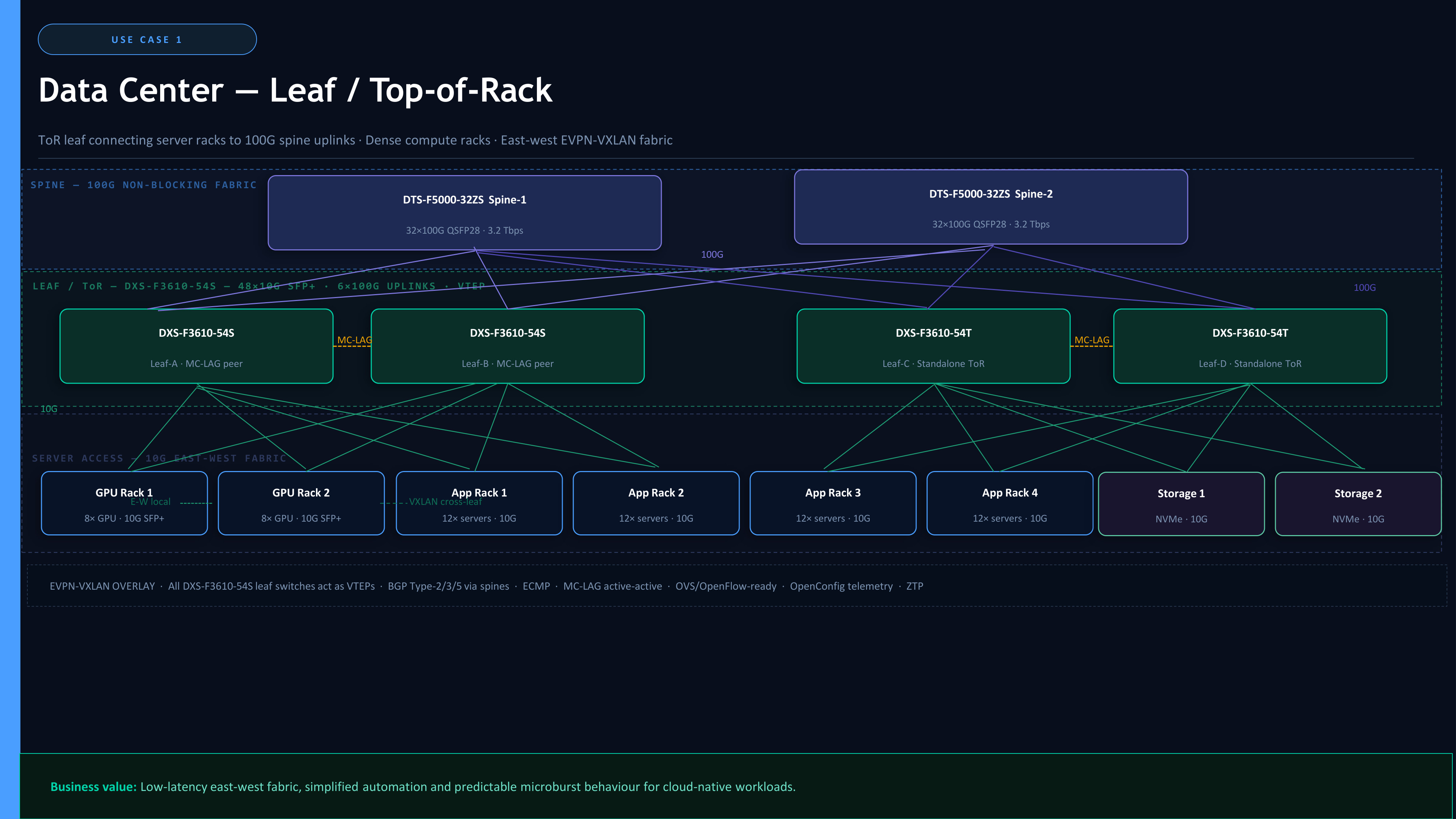
ToR leaf connecting server racks to 100G spine uplinks. Ideal for dense compute racks and east-west application traffic within an EVPN-VXLAN fabric.
Business value:
Low-latency east-west fabric, simplified automation and predictable microburst behaviour for cloud-native workloads.
Overview:
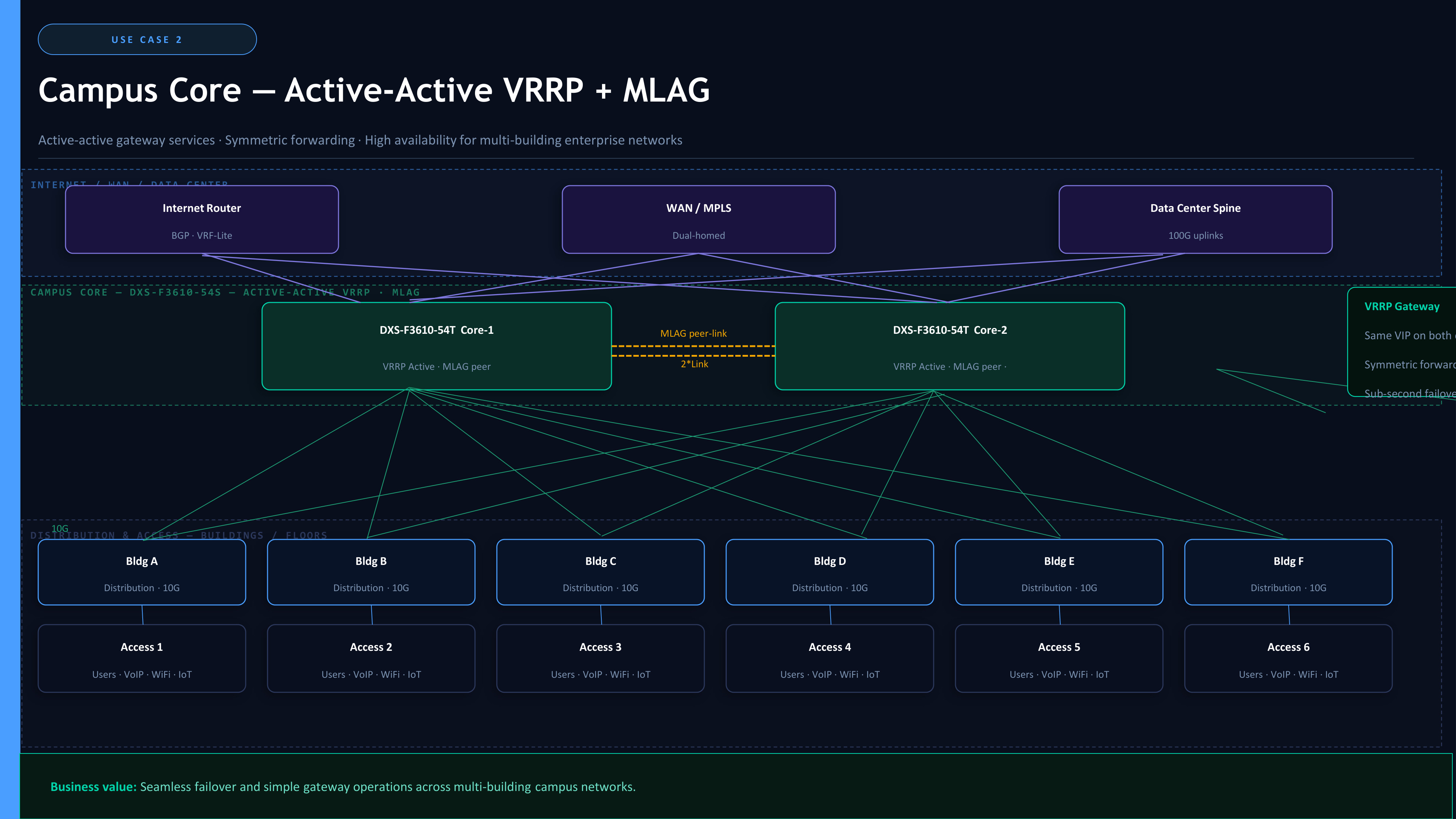
Campus core delivering active-active gateway services with symmetric forwarding and high availability for multi-building enterprise networks.
Business value:
Seamless failover and simple gateway operations across multi-building campus networks.
Overview:
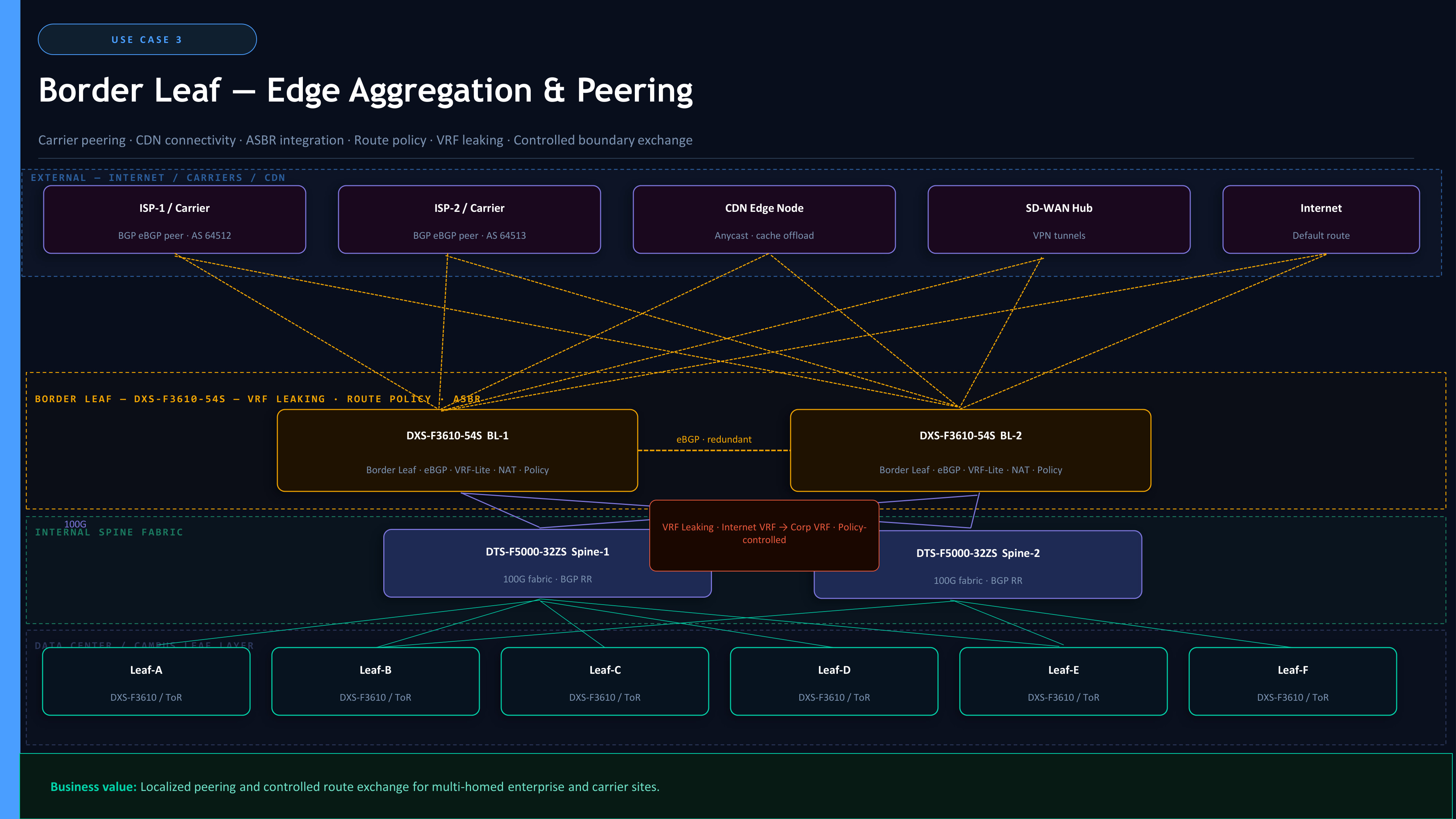
Edge aggregation for carrier peering, CDN connectivity and ASBR integration. Handles route policy, VRF leaking and controlled boundary exchange.
Business value:
Localized peering and controlled route exchange for multi-homed enterprise and carrier sites.
Overview:
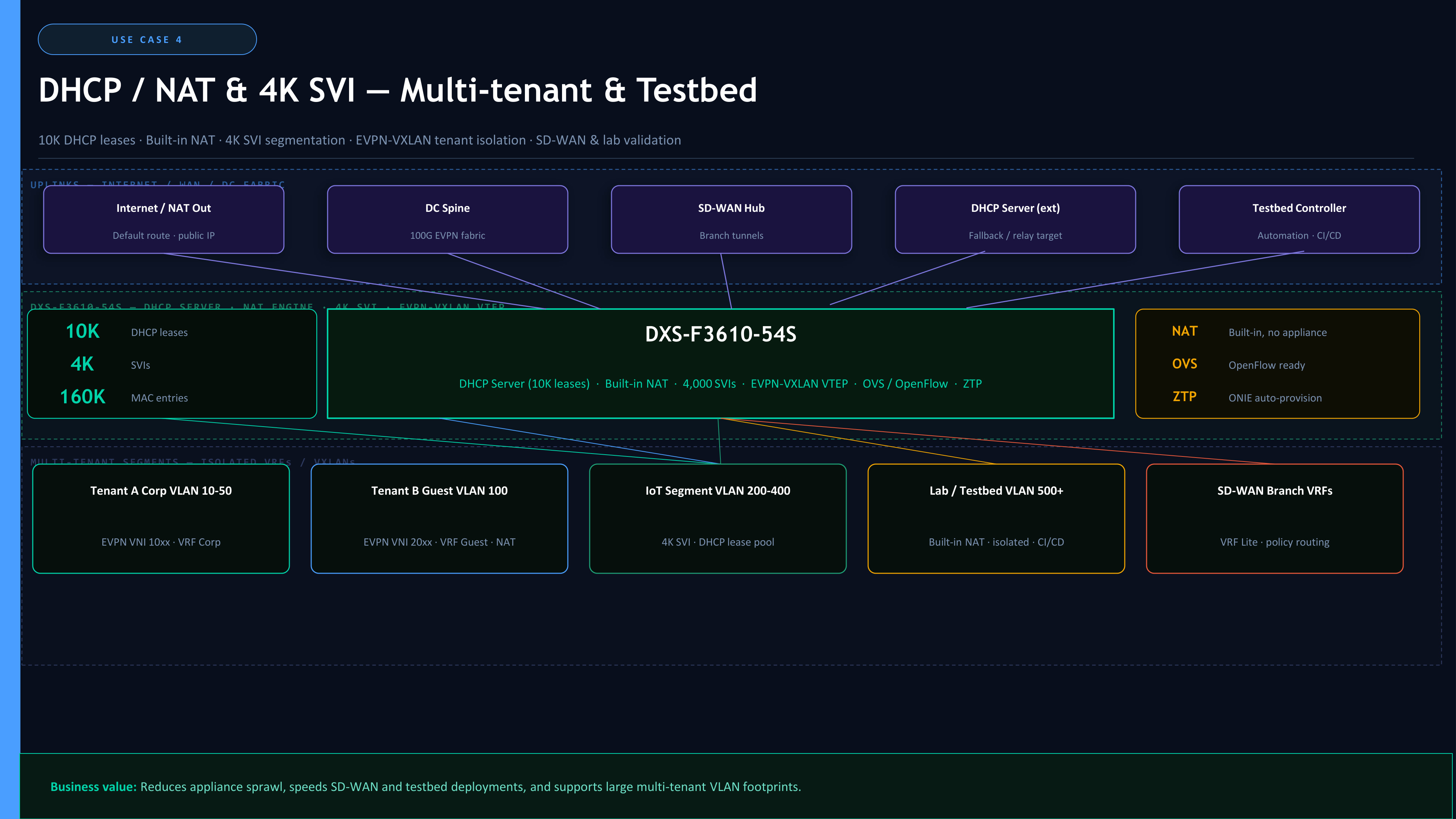
Consolidate DHCP server (10K leases), built-in NAT for labs, and 4K SVI segmentation on one platform. EVPN-VXLAN virtualizes the network from the underlay — enabling isolated tenant or IoT segments at scale.
Business value:
Reduces appliance sprawl, speeds SD-WAN and testbed deployments, and supports large multi-tenant VLAN footprints.
| Switching Capacity | Up to 2.16 Tbps |
|---|---|
| Forwarding Rate | ~1.6 Bpps |
| Packet Buffer | ~32 MB shared (ASIC dependent) |
| MAC Table | ~160K entries |
| SVI Scale | 4,000 SVIs |
| DHCP Relay | Up to 10,000 relay entries (D-Link enhanced) |
| CPU / Memory | x86-class management CPU · up to 16 GB DRAM (SKU dependent) |
| Storage | eMMC + optional SSD for OS images |
| Ports | 48 × 1/10G (SFP+ or 10GBase-T) + 6 × QSFP28 (40/100G) — breakout capable |
| MTU | Jumbo frames up to 9,216 bytes |
| NAT | Built-in NAT for labs and testbeds |
| DC Fabric | EVPN-VXLAN, OVS/OpenFlow, OVSDB, MC-LAG, VRF, ECMP |
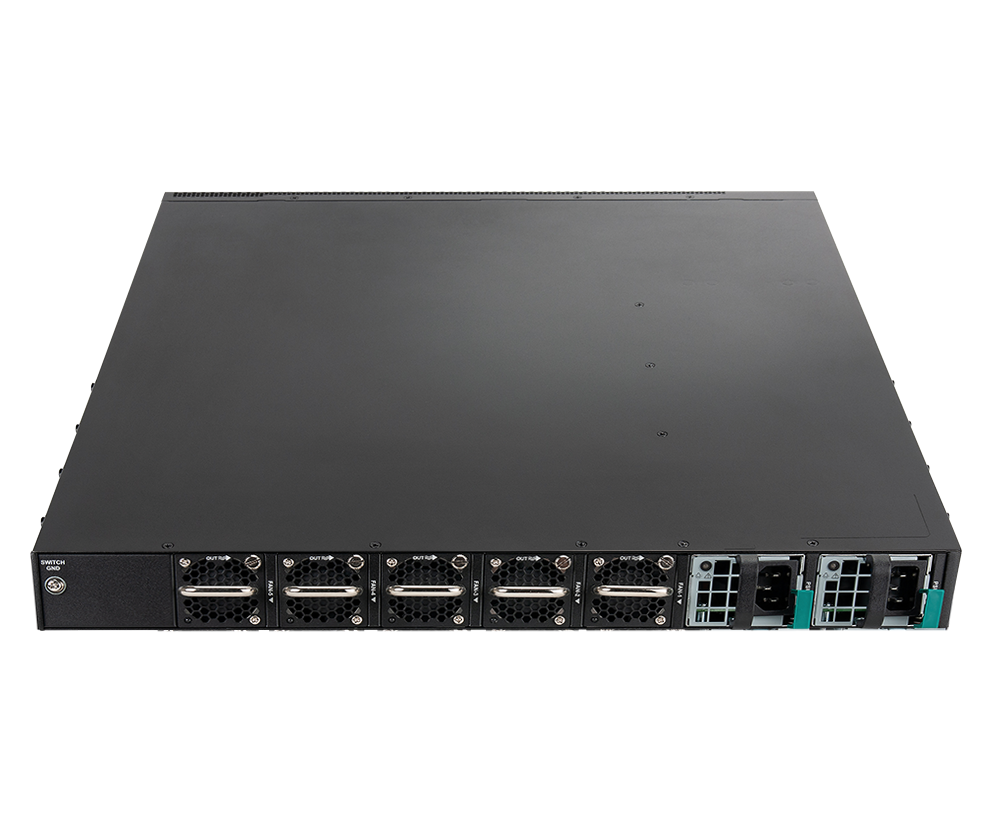
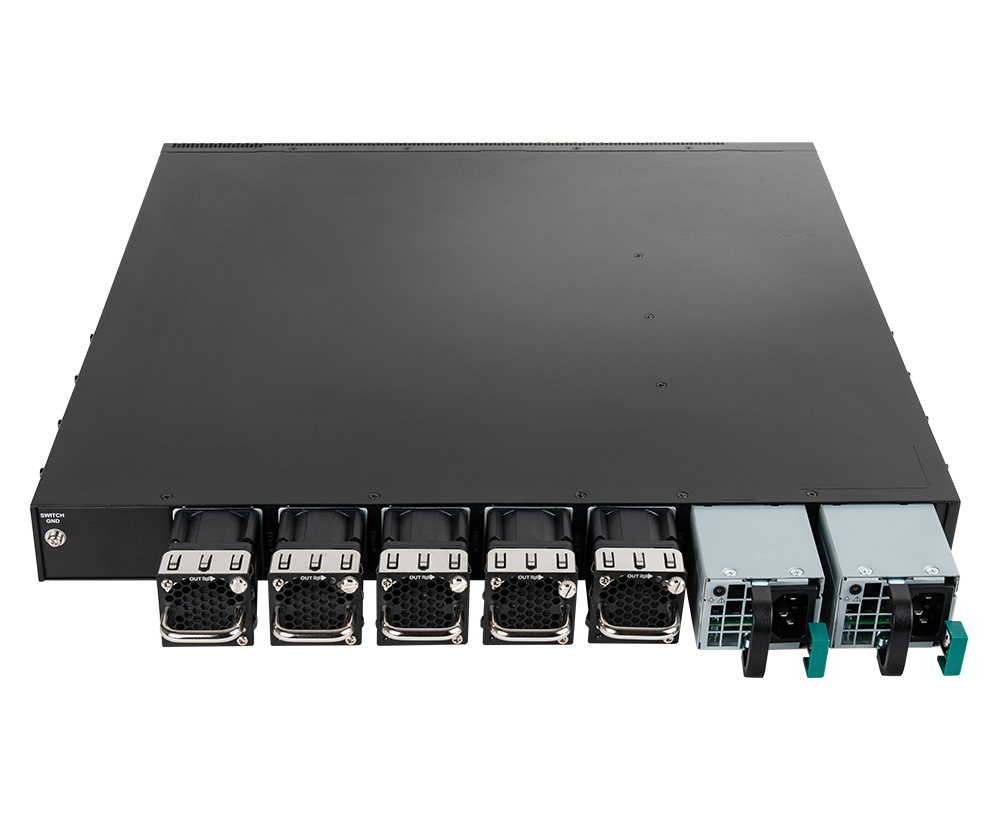
| Power Supply | Redundant AC / optional DC modules (SKU dependent) |
| Cooling | Hot-swap fan modules · front-to-back airflow |
| Management | Console (RJ45), OOB mgmt, USB, SSH, REST/gNMI, SNMP |
| Telemetry | OpenConfig streaming, sFlow, syslog, INT |
| Timing | PTP / NTP support (NOS build dependent) |
| Form Factor | 1U rack-mount, 19" chassis |
| Software | D-LinkNOS (Debian-based open Linux NOS) — ONIE compatible |